

The Evolution of AI: 6 Shifts and the One Skill That Matters Now
- Posted on October 31, 2026
- AI Tools
- By MmantraTech
- 9 Views
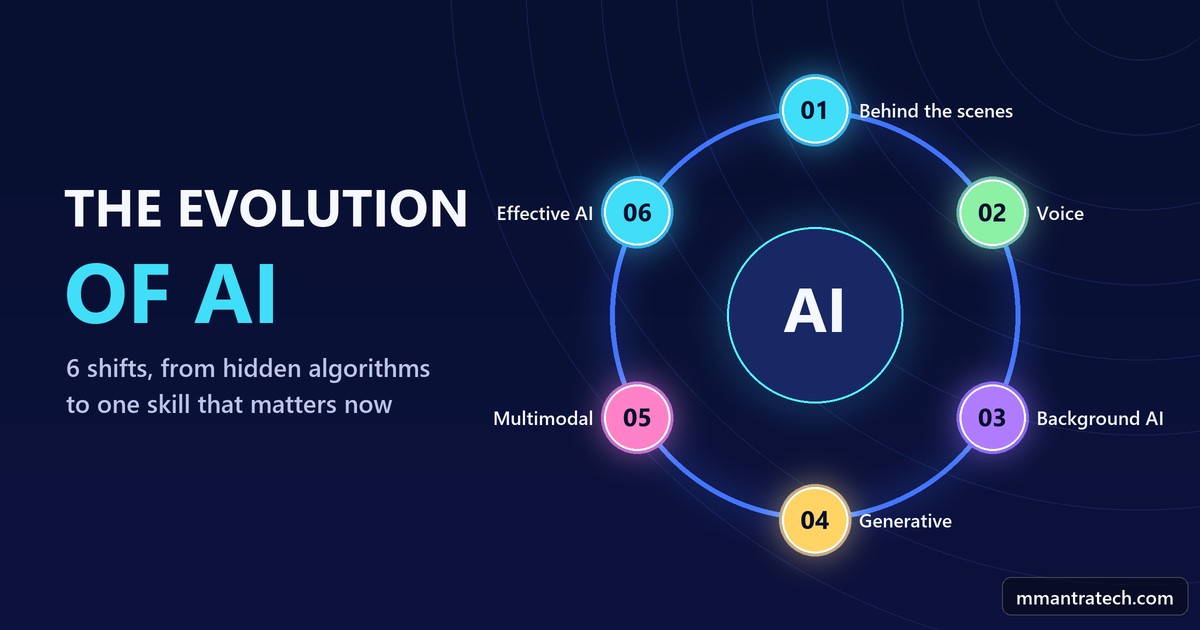
Your phone was using AI long before you ever typed a prompt. It was sorting your spam, ranking your feed, and guessing your next video, and nobody asked you to learn anything.
So what changed? In this breakdown of the evolution of AI, we will walk through six big shifts, from hidden algorithms to the tools we talk to every day. Then we will get to the part that actually matters for you: the one skill that decides who gets real value from all of this.
Table of Contents
- The evolution of AI at a glance
- Shift 1: AI learns from data
- Shift 2: AI gets a voice
- Shift 3: AI disappears into everything
- Shift 4: Generative AI starts creating
- Shift 5: AI moves beyond text
- Shift 6: The era of effective AI
- What this means for students, creators and developers
- FAQ
- Conclusion
The evolution of AI at a glance
Here is the whole story in one table. Watch the last column, because that is where the real change is hiding.
| Shift | Roughly when | What AI did | What you did |
|---|---|---|---|
| 1. Learning from data | 2010s | Found patterns in data | Nothing. You never saw it |
| 2. Voice | 2010 to 2015 | Handled simple commands | Spoke a request |
| 3. Background AI | 2016 to 2019 | Classified, predicted, recommended | Used apps as normal |
| 4. Generative AI | 2020 to 2022 | Created text and code | Had a conversation |
| 5. Multimodal AI | 2023 to 2024 | Worked across text, images, audio and code | Shared files and pictures |
| 6. Effective AI | 2025 onward | Helps with bigger, multi-step work | Direct it and check it |
One honest note: these dates are broad teaching phases, not exact invention dates. AI research goes back to the 1950s, and much of this technology existed well before it became visible to normal people.
Shift 1: AI learns from data
For a long time, software was just rules. If the email contains this word, mark it as spam. Simple, but spammers changed the word and the rule was useless. Somebody then had to write another rule. And another.
Machine learning flipped this. Instead of writing every rule by hand, you show the system thousands of examples and let it find the pattern. More digital data, better hardware and improved algorithms made this practical at a much bigger scale.
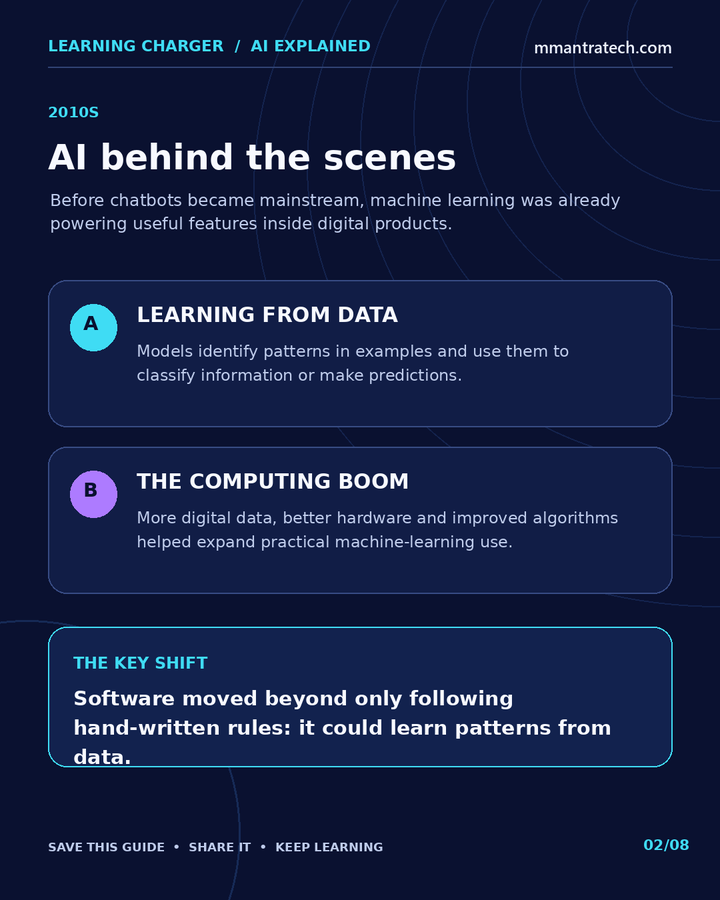
Think of teaching a kid what a dog is. You don't give a definition with 40 conditions. You point at a few dogs, and the kid just gets it. That is roughly the idea.
Shift 2: AI gets a voice
Then AI got a personality, or at least a voice. Siri arrived on the iPhone in 2011. Alexa and Cortana followed in 2014, and Google Assistant came in 2016. So they did not all land together, but the feeling was the same: you could finally talk to your device.
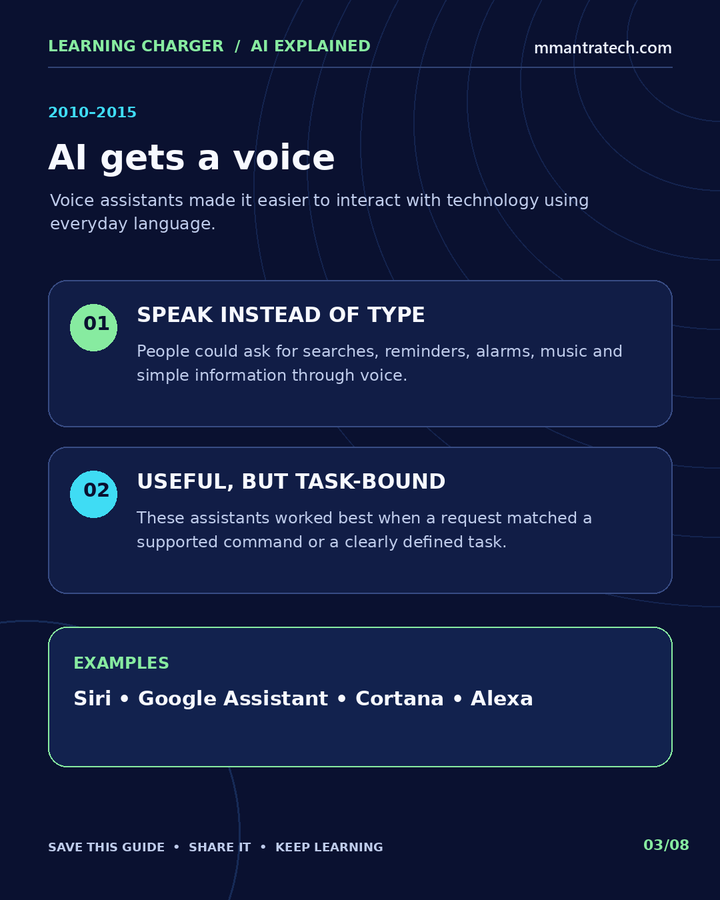
But here's the catch. Set an alarm? Perfect. Ask something slightly outside the script? "Sorry, I didn't get that." We have all been there, repeating the same sentence louder as if the problem was volume.
These assistants sounded natural, but they mostly worked when your request matched a supported task. A friendly voice did not mean real understanding.
Shift 3: AI disappears into everything
This is my favorite phase because almost nobody noticed it. While everyone was laughing at voice assistant fails, AI quietly went to work inside the apps we use daily.
- Your photo app could group pictures of the same person.
- Your inbox got better at catching spam.
- Shopping and video apps started predicting what you might want next.
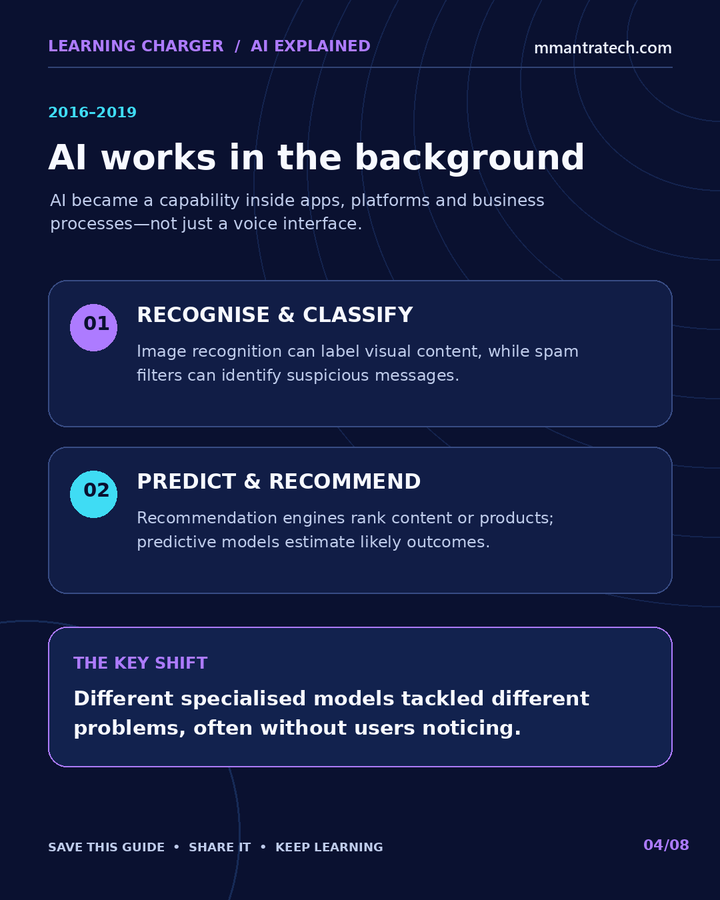
Notice the word "specialized". One model recognized images, another detected fraud, another recommended music. Each one was good at exactly one job. Ask the movie recommender to write an email and you would get nothing.
The lesson here is that AI doesn't need to look like a robot or a chatbot to be useful. Often the best AI is the one you never see.
Shift 4: Generative AI starts creating
Then came the moment everybody remembers. OpenAI released ChatGPT at the end of 2022, and suddenly your parents were asking you about AI.
What was so different? Earlier systems mostly picked from existing things: this is spam, this is a cat, here is a movie. Generative AI makes new things. Large language models can draft an email, explain a concept, summarize a report or write code.
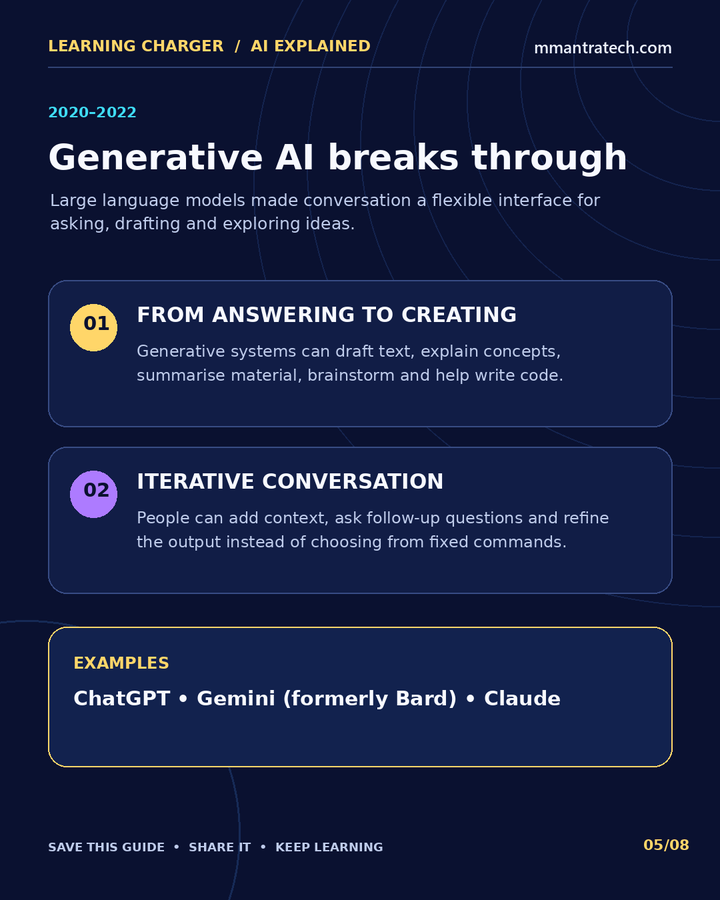
The bigger change was how we used it. You no longer needed to know the right command. You could just say, "make it shorter," or "explain it like I'm 10," and keep going.
A small timeline note, because the image above groups these together. ChatGPT came first. Google's Bard and Claude both followed in March 2023, and Bard was renamed Gemini in 2024.
Generative AI can sound completely confident and still be wrong. Always verify anything important: facts, numbers, references and code.
Shift 5: AI moves beyond text
Next, the models learned to see, listen and work with much more information at once. That is what multimodal AI means: one system that can handle more than one kind of input, like text, images, audio and code.
You can now show a screenshot of an error and ask what went wrong. You can upload a long document and ask questions about it. Releases like Claude 3, Gemini 1.5 and GPT-4o pushed this forward in 2024.
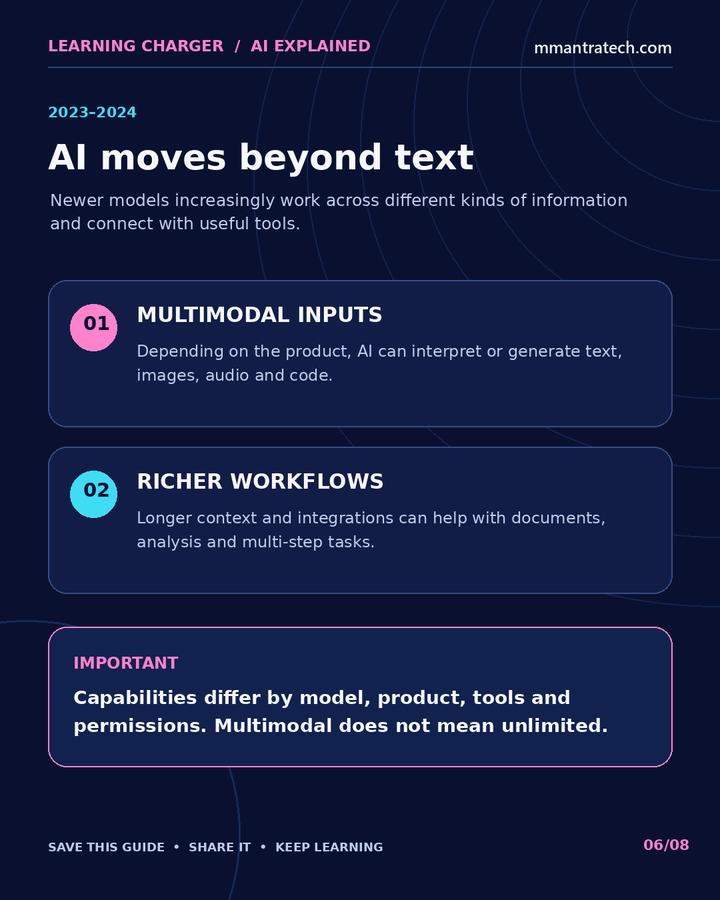
AI also started connecting to other tools, not just talking about them. If you are curious how that works, read my posts on the Model Context Protocol and how AI agents work.
One warning, though. What a tool can do depends on the model, the product, your plan and its permissions. So check before you assume.
Shift 6: The era of effective AI
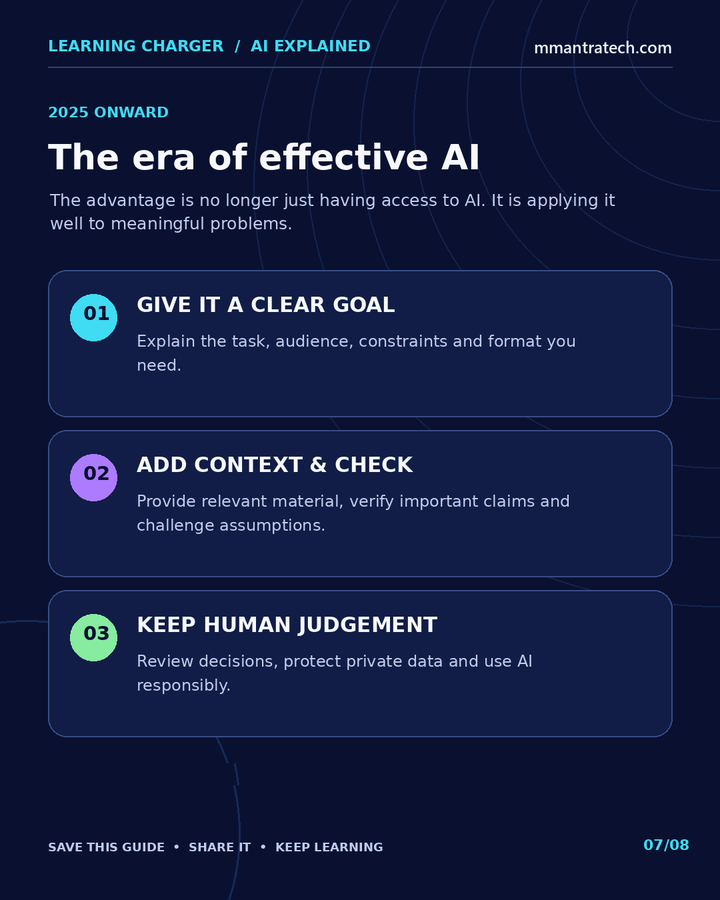
And now we reach the shift that has nothing to do with technology. Today almost anyone can open a free AI chatbot. So having access is no longer an advantage. If everybody has the same tool, the difference is in the person using it.
That is the one skill I keep coming back to: judgment. Knowing what to ask, what to give the AI, and what to do with the answer.
See the difference in one prompt
Here are two people asking for the same thing. First, the lazy way:
# Vague prompt
Write about our new app.
You will get something generic that could describe any app on earth. Now the same request with a goal, audience and limits:
# Clear prompt: goal, audience, context, format
Write a launch post for our tiffin delivery app.
Audience: office workers in Pune who skip lunch.
Key point: orders placed before 11 AM arrive by 1 PM.
Tone: friendly, no hype.
Length: under 80 words, ending with one clear call to action.
Use only the details above. Do not invent offers or prices.
Same AI, completely different result. And that last line matters most, because it stops the AI from making things up.
The habits that separate good users
- Clear goal: Explain the task, audience, limits and format you need.
- Useful context: Share the background and examples the AI can't guess.
- Critical thinking: Check claims, calculations and assumptions.
- Iteration: Treat the first answer as a draft, not the final result.
- Responsible use: Protect private data, respect other people's work, and keep a human accountable.
Honestly, none of this is new. Good managers have done this with people for years. Now everyone gets to practice it. And as I said in AI are our friends, not our owners, the goal is to think better with these tools, not to stop thinking.
What this means for students, creators and developers
All this history is nice, but what should you actually do with it?
Students
Use AI to explain hard topics and create practice questions. But try the problem yourself first. If AI does all your homework, it learns nothing, and neither do you.
Content creators
Let it help with outlines, brainstorming and editing. Your opinion, your experience and your fact-checking are what make people come back.
Developers
AI can explain unfamiliar code, draft tests and speed up boring work. You still own security, architecture and correctness. If it breaks in production, nobody is going to accept "the AI wrote it" as an excuse.
Businesses
AI can support customer service, documents and analysis. But it needs reliable data, clear processes, access controls and human oversight. Buying the tool is the easy part.
FAQ
What are the main stages in the evolution of AI?
A simple way to see it is six stages: machine learning, voice assistants, specialized background AI, generative AI, multimodal AI, and today's focus on using AI effectively.
Is AI new?
No. AI research began in the 1950s. What is newer is how visible and easy to use it has become for everyday people.
What is the difference between traditional AI and generative AI?
Traditional AI usually classifies or predicts, like detecting spam. Generative AI creates new content, like writing a draft or code.
What does multimodal AI mean?
It means a system can work with more than one type of information, such as text, images, audio and code. Exact abilities vary by tool.
Will AI replace human judgment?
AI can speed up parts of a task, but people remain responsible for decisions and outcomes. That is why judgment is becoming more valuable, not less.
Conclusion
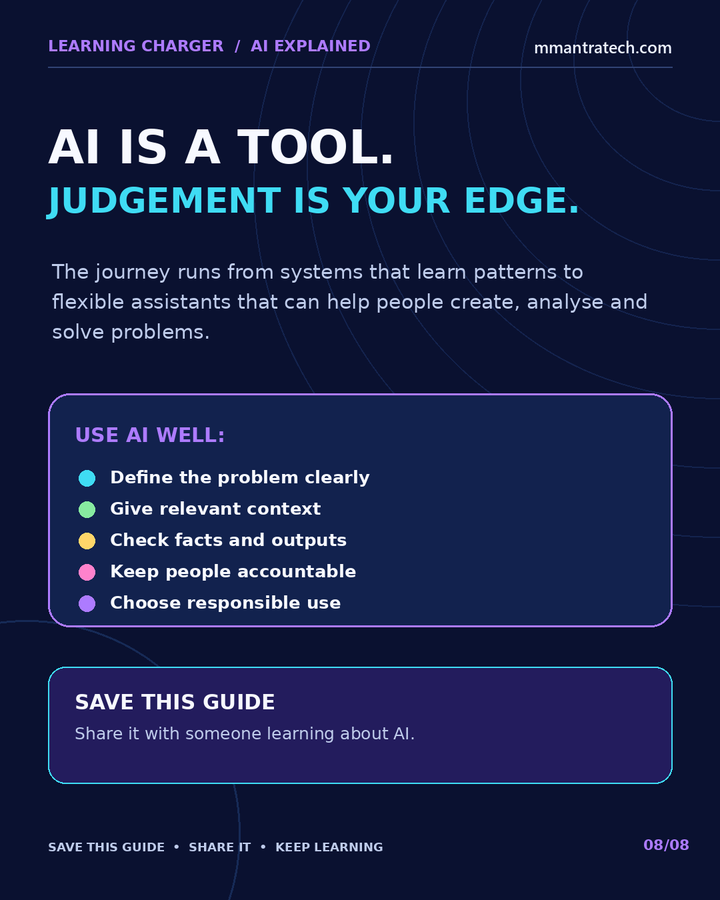
The evolution of AI started with hidden pattern-finding and reached tools that can help us create and work. Three takeaways:
- AI was here before the hype: It worked quietly for years.
- Each shift changed our role: We went from unaware users to the people directing the work.
- Access is common now: Judgment is what sets you apart.
Now tell me: which of these six shifts changed your daily work the most? Drop it in the comments. And if a friend is just getting started with AI, send them this post.


Write a Response