

Multi-Agent AI Explained: When One Agent Isn't Enough
- Posted on August 15, 2026
- AI Tools
- By MmantraTech
- 214 Views
One AI agent can't research, write, and fact-check equally well at once. Here's how CrewAI, AutoGen, and LangGraph let specialized agents divide the work, with a real code example for each.
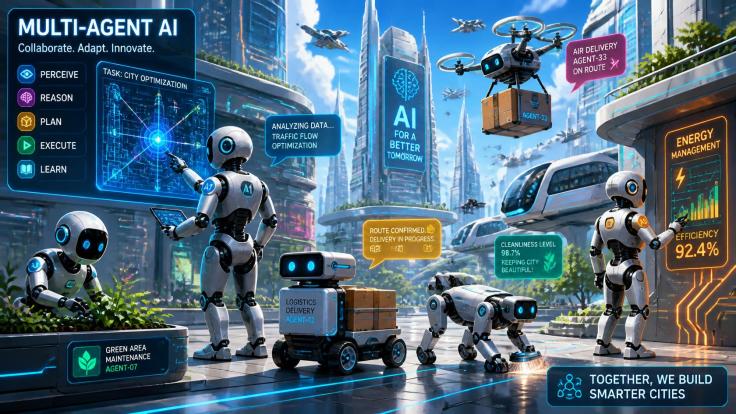
A single AI agent hits a ceiling fast. Ask one model to research a topic, write about it, check its own facts, and polish the tone, and quality drops with every extra job you pile on — the same way one person trying to be their own researcher, writer, and editor produces weaker work than three people who each do one job well.
The fix reshaping AI tooling in 2026 is multi-agent orchestration: instead of one model doing everything, specialized agents each own one job and hand their output to the next. This post covers the frameworks that make this real, with a working example for each — plus a full walkthrough of building a 3-agent pipeline from scratch.
Table of Contents
- Why one agent isn't enough
- The multi-agent framework cheat sheet
- Every framework explained with a real example
- Building a 3-agent pipeline end to end
- Why reliability is the real 2026 battleground
- Key takeaways
Why one agent isn't enough
A single AI agent has one context window and one "mindset" running through an entire task. When that task involves genuinely different skills — deep research, creative writing, strict fact-checking — the model keeps switching hats inside the same conversation, and quality suffers with each switch.
Multi-agent orchestration splits a big goal into narrow roles, each run by its own agent with its own instructions, its own tools, and often its own model. A Researcher agent never has to write prose; a Writer agent never has to verify sources — each one gets better at a narrower job.
The trade-off is coordination: something has to decide who goes first, what gets passed along, and when the whole thing is actually done. That coordination layer is exactly what the frameworks below provide.
The multi-agent framework cheat sheet
A quick reference before the deep dive.
| Framework | Coordination style | Real example | Best for |
|---|---|---|---|
| CrewAI | Role-based "crew" — agents work in a defined order like a team | Researcher → Writer → Editor content pipeline | Clear, linear workflows |
| AutoGen | Conversable agents that critique and revise each other's output | Coder agent + Reviewer agent looping until tests pass | Iterative back-and-forth tasks |
| LangGraph | Stateful graph — agents can loop, branch, and retry based on conditions | Retry a research step automatically if confidence is low | Complex, non-linear workflows |
Every framework explained with a real example
👥 CrewAI — agents as job roles
CrewAI models a multi-agent system the way you'd describe a real team: each Agent gets a role, a goal, and a backstory that shapes how it approaches work, and a Crew runs a list of Tasks across them in order.
# A 3-agent content crew: research, write, edit
from crewai import Agent, Task, Crew

researcher = Agent(
    role="Researcher",
    goal="Find accurate, current facts on the given topic",
    backstory="A meticulous analyst who never states an unverified claim."
)

writer = Agent(
    role="Writer",
    goal="Turn research notes into a clear, engaging draft",
    backstory="A writer who explains technical ideas in plain language."
)

editor = Agent(
    role="Editor",
    goal="Tighten the draft and flag any unsupported claims",
    backstory="A sharp editor who cuts fluff and checks every fact."
)

research_task = Task(description="Research current AI agent adoption trends", agent=researcher)
write_task = Task(description="Write a short article from the research notes", agent=writer)
edit_task = Task(description="Edit the draft for clarity and accuracy", agent=editor)

crew = Crew(agents=[researcher, writer, editor], tasks=[research_task, write_task, edit_task])
result = crew.kickoff()
Realistic result: the Researcher's notes flow directly into the Writer's prompt, and the Writer's draft flows into the Editor's — each agent only ever sees the input relevant to its own job, not the entire history.
💬 AutoGen — agents that argue until the work is right
AutoGen (from Microsoft) is built around agents having an actual back-and-forth conversation. The classic pattern is a coding agent paired with a reviewing agent that keeps sending work back until it's actually correct.
# A coder agent and a reviewer agent loop until the code passes review
from autogen import AssistantAgent, UserProxyAgent

coder = AssistantAgent(
    name="Coder",
    system_message="Write Python functions based on the task. Revise based on reviewer feedback."
)

reviewer = AssistantAgent(
    name="Reviewer",
    system_message="Review the code for bugs and edge cases. Approve only when it's correct."
)

user_proxy = UserProxyAgent(name="User", human_input_mode="NEVER")

user_proxy.initiate_chat(
    coder,
    message="Write a function that finds duplicate emails in a list of user records."
)
Realistic result: the Coder proposes a function, the Reviewer points out an unhandled edge case (like case-sensitive email matching), and the Coder revises — automatically, without you relaying feedback by hand.
🔀 LangGraph — when the workflow isn't a straight line
CrewAI and AutoGen both assume a roughly linear or conversational flow. LangGraph is for when the workflow needs to branch — retry a step, skip ahead, or loop back based on a condition the agents themselves decide.
Example scenario: a research step runs, a "confidence check" node evaluates the result, and if confidence is low, the graph loops back to research again with a refined query — instead of passing weak results forward regardless.
This is the right tool once "always do step 2 after step 1" stops being true for your workflow — most teams start with CrewAI's simplicity and move to LangGraph only when they hit that wall.
Building a 3-agent pipeline end to end
Here's the shape almost every real multi-agent system follows, regardless of framework — a Planner, an Executor, and a Reviewer:
- Planner breaks the goal into concrete steps. Given "write a comparison of three project management tools," it outputs a numbered plan: research each tool's pricing, list features, draft the comparison.
- Executor carries out each step in the plan, one at a time, using whatever tools it has access to (web search, a code interpreter, a file writer).
- Reviewer checks the Executor's output against the original goal before it's considered done — catching missed steps or unsupported claims the Executor's own output doesn't flag itself.
# Minimal Planner -> Executor -> Reviewer loop (framework-agnostic pseudocode)
plan = planner_agent.run(goal="Compare Asana, Monday.com, and ClickUp pricing")

for step in plan.steps:
    result = executor_agent.run(step)
    review = reviewer_agent.run(goal=plan.goal, result=result)
    if not review.approved:
        result = executor_agent.run(step, feedback=review.feedback)
Realistic result: if the Executor's pricing data is outdated or a tool is missing from the comparison, the Reviewer catches it and sends the step back before the pipeline reports itself finished — the same safety net a human editor gives a single writer.
Why reliability is the real 2026 battleground
The harder a multi-agent system works unsupervised, the more it needs to fail gracefully. A single agent making one mistake is a bad answer; three agents compounding each other's mistakes across a long pipeline can drift much further from the goal before anyone notices.
That's why the current focus across every major framework isn't "can agents do more" — it's can they be trusted to do it reliably: recovering from a failed step instead of silently continuing, staying within the original goal instead of drifting, and leaving a traceable record of what each agent actually did.
Key takeaways
- Split the job, not the model. Multi-agent systems work by giving each agent a narrow role, not by making one model try to do everything at once.
- Pick the coordination style that matches your workflow. CrewAI for linear pipelines, AutoGen for iterative critique loops, LangGraph once you need branching or retries.
- Reliability matters more as autonomy grows. A Reviewer step that can send work back is what keeps a multi-agent pipeline trustworthy instead of just fast.
Individual agents are worth using today for real, bounded tasks — but the moment a job genuinely needs more than one skill done well, a small team of agents will consistently outperform asking one agent to do it all.



Write a Response